Exploring software engineering via PDF resources reveals evolving methodologies, tools, and best practices, focusing on code quality and robust error handling techniques.
PDF documents offer insights into iterative development, balancing documentation needs, and understanding principles crucial for modern software projects and team collaboration.
The Current Landscape of Software Engineering (as of 02/27/2026)
As of today, February 27th, 2026, software engineering is heavily influenced by a pragmatic shift towards adaptable methodologies and a renewed focus on code maintainability. PDF resources highlight a growing emphasis on understanding how developers think when crafting, reviewing, and refining code. The field is actively integrating new tools and practices, driven by the need for faster delivery cycles and increased software reliability.
Current trends, documented in available PDFs, demonstrate a move beyond rigid frameworks, advocating for selecting methods best suited to specific project constraints. Iterative and incremental development remain central, minimizing risks. Simultaneously, there’s a recognition that documentation, while vital, often faces pressure from project timelines, necessitating a strategic balance between thoroughness and expediency. The focus is on creating accurate, usable documentation, especially close to the code itself.
Importance of Documentation in Software Engineering
PDF resources consistently underscore the critical, yet often compromised, role of documentation in software engineering. While universally acknowledged as essential, documentation frequently becomes a “balancing item” during projects constrained by time. This leads to a common scenario where documentation suffers, forcing maintainers and developers to adapt their workflows accordingly.
However, effective documentation remains paramount for long-term project success. The closer documentation aligns with the actual code, the more valuable it becomes to software engineers. Accurate documentation facilitates understanding, reduces errors, and streamlines maintenance. PDFs emphasize that neglecting documentation creates technical debt, increasing future costs and hindering adaptability. A strategic approach, prioritizing clarity and proximity to the code, is vital for maximizing documentation’s impact.

Core Principles of Software Development
PDFs highlight iterative and incremental development as key principles, minimizing risks through adaptable methods and a framework for selecting optimal project approaches.
Iterative and Incremental Development

Iterative and incremental development, as detailed in software engineering PDFs, represents a cyclical process where software grows through repeated cycles of planning, analysis, design, implementation, and testing. This contrasts sharply with the older “waterfall” model. Each iteration produces a working, albeit incomplete, version of the software.
Incremental development focuses on delivering parts of the functionality in increments, while iterative development refines existing functionality. PDFs emphasize that combining both approaches minimizes risks, allowing for early feedback and adaptation to changing requirements. This methodology enables teams to choose methods best suited to their specific project constraints and complexities, fostering a more responsive and adaptable development lifecycle.
The benefits, outlined in various resources, include reduced project risks, improved quality, and increased customer satisfaction through continuous involvement and demonstrable progress.
Frameworks for Describing Software Development Principles
Software engineering PDFs highlight the necessity of frameworks to articulate core development principles, providing a common vocabulary and understanding for teams. These frameworks aid in selecting the most appropriate methodologies for a given project, acknowledging that no single approach fits all scenarios.
Resources like those from the Software Engineering Institute present structures for characterizing constraints impacting software development, such as time, budget, and technical limitations. These frameworks enable informed decisions regarding process selection and risk management. They emphasize understanding the trade-offs inherent in different approaches.
Effective frameworks facilitate communication and collaboration, ensuring all stakeholders share a consistent understanding of the project’s guiding principles and the rationale behind chosen development practices, ultimately leading to more successful outcomes.
Balancing Documentation with Project Timelines
Software engineering PDFs consistently address the challenge of balancing comprehensive documentation with often-tight project timelines. Many projects face pressure to prioritize feature delivery, leading to documentation being viewed as a secondary, expendable item.
However, neglecting documentation can significantly hinder long-term maintainability and knowledge transfer. Resources emphasize that documentation accuracy is paramount, particularly when closely tied to the codebase. A pragmatic approach is advocated, prioritizing detailed documentation for critical components.
The rule of thumb suggests that documentation should be more precise the closer it is to the code itself, acknowledging that developers and maintainers adapt their workflows based on documentation availability and quality, striving for a practical equilibrium.

Best Practices in Software Engineering
PDF resources highlight code quality, readability, and effective naming conventions, alongside robust error handling and test-driven development for superior software outcomes.
Code Quality: Identifying Good vs. Bad Code
PDF guides emphasize discerning good code through clarity, conciseness, and maintainability, contrasting it with “bad code” characterized by complexity and obscurity. Identifying these qualities is paramount.
Key indicators of good code include well-defined functions, objects, and classes, adhering to established naming conventions for enhanced readability. Conversely, “code smells” – patterns suggesting deeper problems – signal potential issues.

PDF resources detail heuristics for spotting poor code, such as duplicated logic, long methods, and excessive coupling. Understanding these allows developers to proactively refactor and improve codebases, ensuring long-term stability and reducing technical debt. A knowledge base is essential.
Writing Clean and Readable Code
PDF resources consistently highlight the importance of writing code that is easily understood, not just by machines, but primarily by other developers – and your future self. Clean code minimizes ambiguity and cognitive load.
Techniques include utilizing meaningful variable and function names, employing consistent indentation and whitespace, and breaking down complex logic into smaller, manageable units. PDF guides advocate for a style that prioritizes clarity over cleverness.
Furthermore, these documents stress the value of comments – not to explain what the code does, but why it does it. Transforming bad code into good code requires deliberate effort and adherence to established principles, fostering collaboration and maintainability.
Naming Conventions for Code Elements
PDF resources dedicated to software engineering best practices emphasize that well-chosen names are crucial for code readability and maintainability. A clear naming scheme significantly reduces the effort required to understand the purpose of variables, functions, and classes.
These guides advocate for descriptive names that accurately reflect the element’s role, avoiding single-letter variables or ambiguous abbreviations. Consistency is key; adopting a project-wide convention (e.g., camelCase, PascalCase) is highly recommended.
PDFs often detail how naming should convey intent – for example, using verbs for function names and nouns for class names. Good names minimize the need for excessive commenting, contributing to cleaner, more self-documenting code.
Designing Effective Functions, Objects, and Classes
PDF guides on software engineering consistently highlight the importance of cohesive and loosely coupled designs. Effective functions should have a single, well-defined purpose, promoting reusability and simplifying testing. Objects should encapsulate data and behavior, hiding internal complexity.
Classes, according to these resources, should represent clear abstractions, adhering to principles like the Single Responsibility Principle. PDFs detail how to avoid overly complex classes with too many responsibilities, advocating for smaller, more manageable units.
Proper design minimizes dependencies between components, making the system more flexible and easier to modify. These documents emphasize that thoughtful design upfront saves significant effort during maintenance and future development.
Code Formatting for Readability
Software engineering PDFs universally stress that code is read far more often than it’s written, making readability paramount. Consistent formatting—indentation, spacing, and line breaks—significantly enhances comprehension. These resources advocate for established style guides, ensuring uniformity across projects and teams.
PDFs detail how whitespace strategically used can visually group related code, improving clarity. They also emphasize the importance of limiting line length to avoid horizontal scrolling, a major impediment to reading. Consistent naming conventions, as covered in related PDFs, complement formatting.
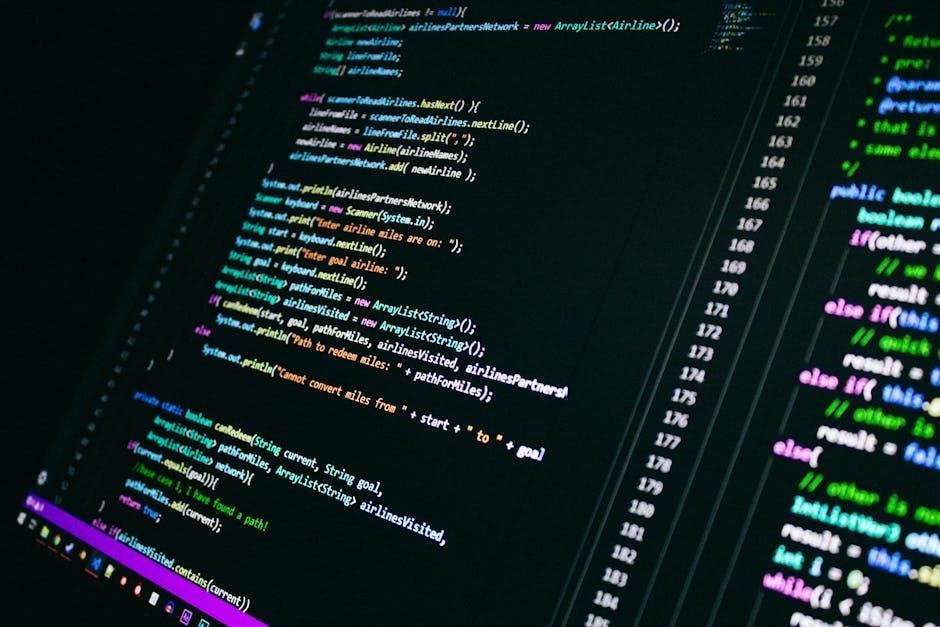
Automated code formatters are frequently recommended, enforcing style rules and reducing subjective debates, ultimately leading to cleaner, more maintainable codebases.

Error Handling and Testing
PDF resources highlight robust error handling and comprehensive testing as vital, including unit testing and test-driven development, to identify and resolve code smells.
Implementing Robust Error Handling
PDF guides emphasize that effective error handling is paramount in software engineering, going beyond simply catching exceptions. It’s about anticipating potential issues and designing systems that gracefully recover or provide informative feedback. Resources detail strategies for implementing complete error handling without obscuring core code logic – a delicate balance.
These documents advocate for clear error messages, logging mechanisms, and strategies for preventing errors from cascading. They stress the importance of distinguishing between expected and unexpected errors, handling each appropriately. Furthermore, PDFs showcase techniques for creating resilient systems that minimize the impact of failures on the user experience, ensuring stability and reliability. Proper error handling isn’t just about fixing bugs; it’s about building trustworthy software.
Unit Testing and Test-Driven Development
PDF resources consistently highlight unit testing and Test-Driven Development (TDD) as cornerstones of quality software. They explain how TDD involves writing tests before writing the code itself, driving development with a clear understanding of desired functionality. This approach fosters a more modular and testable codebase.
These documents detail the benefits of automated testing, including early bug detection, improved code coverage, and simplified refactoring. They showcase how unit tests isolate individual components, verifying their behavior in isolation. PDFs also emphasize the importance of writing comprehensive test suites that cover various scenarios, including edge cases and error conditions, ultimately leading to more reliable and maintainable software.
Heuristics and Smells for Identifying Poor Code
PDF guides on software engineering emphasize recognizing “code smells” – indicators of deeper problems. These heuristics, like long methods, duplicated code, and large classes, signal potential maintainability issues. Resources detail how these smells often lead to increased complexity and a higher risk of bugs.
Documents explain that identifying these patterns isn’t about rigid rules, but about prompting investigation; They advocate for understanding why a smell exists, rather than blindly refactoring. PDFs also cover techniques for applying heuristics to assess code quality, promoting a proactive approach to preventing technical debt and ensuring a cleaner, more understandable codebase for long-term project success.

Tools and Methodologies
PDF resources highlight new software development methodologies and the tools supporting them, enhancing efficiency and code quality through collaborative practices.
New Methodologies in Software Development
PDF documents detailing modern software engineering practices emphasize iterative and incremental development approaches, minimizing project risks by delivering functional software in cycles. These methodologies prioritize adaptability and continuous improvement, responding effectively to evolving requirements.
The focus shifts towards selecting methods best suited for specific project constraints, leveraging a framework for understanding development principles. Contemporary PDFs showcase a move beyond rigid, waterfall models, advocating for agile techniques and collaborative workflows.
These resources also explore how to balance the need for thorough documentation with project timelines, recognizing documentation’s crucial role in maintainability and knowledge transfer. Ultimately, the goal is to create a knowledge base that informs how developers write, read, and refine code.
Utilizing Software Engineering Tools
PDF resources highlight the importance of leveraging software engineering tools for enhanced code quality and efficiency; These tools aid in identifying “smells” and heuristics indicative of poor code, enabling developers to proactively address potential issues.
Modern PDFs detail techniques for implementing robust error handling without compromising code clarity, alongside best practices for unit testing and test-driven development. They emphasize the value of automated testing frameworks in ensuring software reliability.
Furthermore, these documents showcase tools that facilitate clean code practices – focusing on naming conventions, effective function design, and consistent code formatting for maximum readability. The ultimate aim is to empower developers to produce maintainable, scalable, and well-documented software solutions.

Advanced Topics & Considerations
PDFs explore software maintenance, adaptability, and the software engineer’s evolving role, emphasizing project management and collaborative team dynamics for success.
Software Maintenance and Adaptability
PDF resources highlight that software maintenance isn’t merely bug fixing; it’s a continuous process of adaptation. As requirements evolve and technologies advance, maintaining software necessitates understanding its original design and anticipating future needs. Documentation, often compromised due to time constraints – as noted in van Vliet’s work – becomes critically important for maintainability.
Adaptability requires modular design and adherence to clean coding principles, enabling easier modification and extension. PDFs emphasize the importance of unit testing and test-driven development to ensure changes don’t introduce regressions. Furthermore, recognizing “smells” and heuristics in code, as detailed in best practice guides, aids in proactively identifying areas needing refactoring. Ultimately, successful software maintenance ensures longevity and continued value.
The Role of the Software Engineer
PDF resources consistently portray the software engineer as more than just a coder; they are problem solvers, designers, and communicators. The ability to discern “good” from “bad” code, as emphasized in several guides, is paramount. This requires a deep understanding of principles like clean code, effective naming conventions, and well-structured functions and classes.
Furthermore, the role demands a commitment to continuous learning and adaptation, staying abreast of new methodologies and tools. Collaboration with project managers and team leads is crucial, requiring clear communication and a shared understanding of project goals. Ultimately, the software engineer’s responsibility extends beyond delivering functional code to creating maintainable, adaptable, and valuable software solutions.
Project Management and Team Collaboration
PDF documentation highlights the critical interplay between effective project management and seamless team collaboration in software engineering. Successful projects necessitate a shared vocabulary and understanding of development principles, enabling informed decisions about methodology selection. Iterative and incremental approaches, frequently discussed, minimize risks and facilitate adaptation to changing requirements.
Collaboration isn’t merely about co-existing; it’s about leveraging diverse skills and perspectives. Clear communication, well-defined roles, and a commitment to code quality – including robust error handling and thorough testing – are essential. Project managers must balance documentation needs with project timelines, ensuring maintainability without sacrificing speed, fostering a productive and cohesive team environment.

Resources & Further Learning (PDF Focus)
PDF resources provide a knowledge base for software engineering, detailing code quality, error handling, and best practices for developers and project teams.
Leveraging PDF Documents for Software Engineering Knowledge
PDF documents serve as invaluable repositories of concentrated software engineering expertise, offering a structured approach to learning and applying best practices. They frequently encapsulate comprehensive guides on methodologies, tools, and techniques, providing a portable and readily accessible format for continuous professional development.
These resources often detail the nuances of iterative and incremental development, emphasizing the importance of balancing thorough documentation with project timelines. PDFs can present in-depth analyses of code quality, differentiating between effective and problematic code structures, alongside practical advice on crafting clean, readable, and well-formatted code.
Furthermore, PDFs frequently cover robust error handling strategies, unit testing methodologies, and heuristics for identifying code smells, empowering engineers to build more reliable and maintainable software systems. Accessing these curated collections of knowledge accelerates skill enhancement and promotes consistent application of industry standards.
Key PDF Resources for Software Engineering Best Practices
Several key PDF resources consistently emerge as foundational texts for software engineering best practices. “Software Engineering: New Methodologies, Tools, and Best Practices in Software Development” provides a comprehensive knowledge base for writing, reading, and refining code, focusing on identifying and rectifying poor code quality.
“Principles and Practices of Software Development” by Daniel Huttenlocher offers a framework for selecting appropriate development methods, emphasizing iterative and incremental approaches to minimize project risks. “Software Engineering: Principles and Practice” by Hans van Vliet addresses the critical balance between documentation and project constraints, highlighting the need for accurate documentation close to the code.
These PDFs collectively offer guidance on naming conventions, function design, error handling, and test-driven development, equipping engineers with the skills to produce high-quality, maintainable software. Regularly consulting these resources ensures adherence to current industry standards and promotes continuous improvement.